
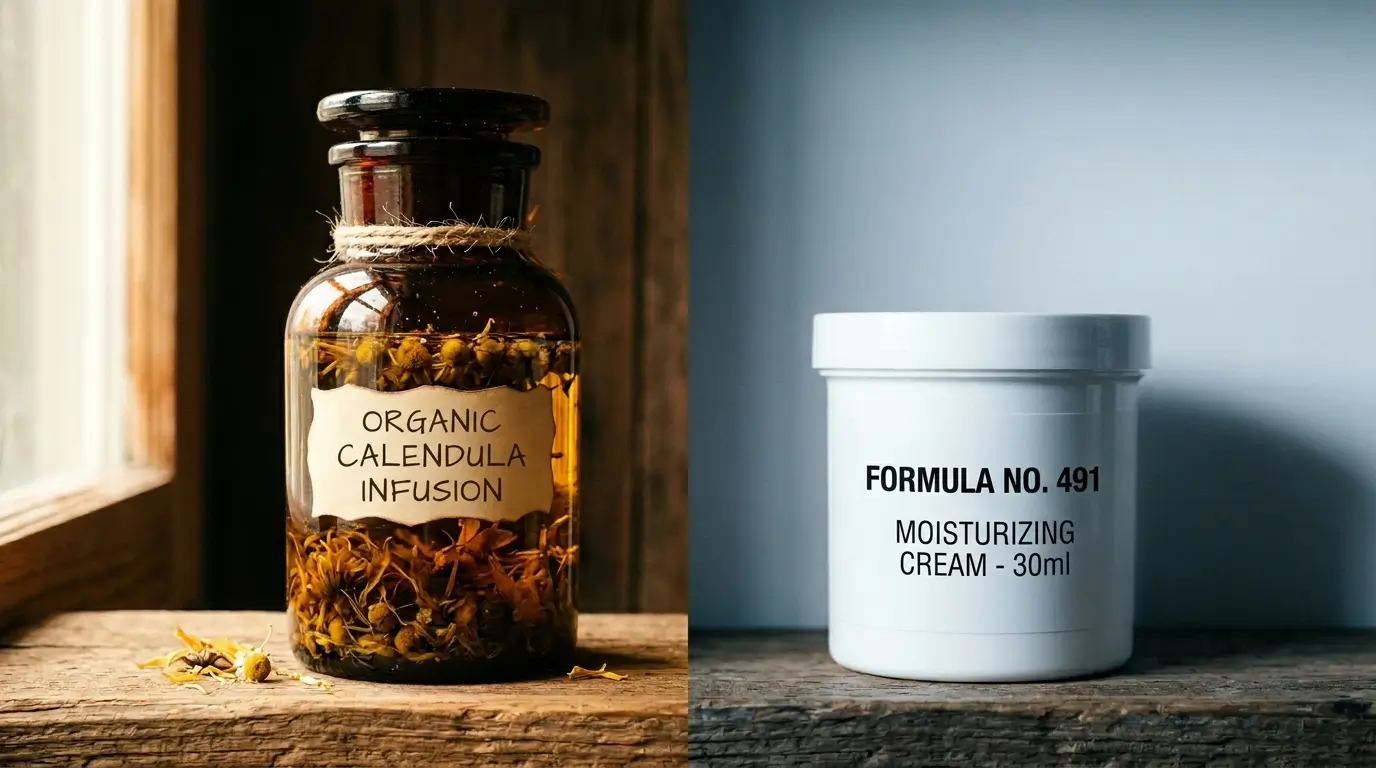
The Workshop Ledger
Why Your Skin Can’t Breathe Under Petroleum
If you look at the back of a mass-produced hand cream, you’ll likely see Paraffinum Liquidum at the top of the list. It’s cheap, it’s dead, and it’s a byproduct of the oil industry. As a medical herbalist, I see the damage this does to working hands every day. It doesn't feed the skin; it just seals it off. In this post, we’re looking at the actual science of why biological plant oils sink in while petroleum just sits on the surface—and why that distinction matters for your skin’s survival.
In the world of commercial skincare, there is one ingredient that reigns supreme because it is cheap, shelf-stable, and entirely dead: Paraffinum Liquidum . You’ll know it as petroleum jelly or mineral oil.
As a herbalist, I get asked all the time: “If it’s been used for decades, why is it a problem?”
The answer isn’t about “toxins” or marketing buzzwords. It’s about the fundamental difference between an occlusive barrier and biological support.
The Dead Barrier vs. The Living Oil
Petroleum is a byproduct of the oil industry. It is a large-molecule hydrocarbon. Because those molecules are so big, they cannot be absorbed by human skin. Instead, they sit on top like a layer of clingfilm.
This is what we call an occlusive . In very specific medical settings (like protecting a fresh wound from infection), that barrier is useful. But for daily gardening hands? It’s a disaster.
It traps heat and moisture: By sealing the skin completely, you disrupt the skin’s natural “breathing” (gas exchange) and its ability to regulate temperature.
It offers zero nutrition: Petroleum contains no fatty acids, no vitamins, and no antioxidants. It provides the feeling of softness because it smooths down the rough edges of dry skin cells, but once you wash it off, the skin underneath is exactly as damaged as it was before.
Why Plant-Infused Oils are Bio-Available
When we talk about the magic of our Plantain-infused Olive or Borage oils, we’re actually talking about biocompatibility.
The skin’s surface is made of a lipid bilayer. Plant oils—especially those rich in linoleic and gamma-linolenic acids (GLA)—have a molecular structure that your skin actually recognises.
Absorption: Unlike petroleum, these oils can actually move into the stratum corneum (the top layer of skin). They don’t just sit there; they integrate.
Constituents: By slowly infusing herbs like Plantain and Calendula into these oils, we are using the oil as a solvent to extract specific compounds—like allantoin for cell proliferation and aucubin for its anti-inflammatory properties.
The Result: You aren’t just masking the dryness. You are delivering the chemical building blocks the skin needs to repair its own barrier.
The Honest Truth
If you want a quick fix that makes your hands feel slippery and “smooth” for ten minutes, buy the cheap tub from the chemist.
But if you want to support the biological function of your skin—if you want to mend the damage caused by cold soil and constant washing—you need a product that speaks the same language as your body. That’s why we spend weeks infusing plants into oils instead of just pumping a synthetic base out of a vat.
One is a mask. The other is medicine.
More from The Workshop Ledger

Does Hand Cream Expire? Natural Skincare Shelf Life Guide
Yes, hand cream expires. Natural formulations last 6-12 months. Learn the signs of expired cream and how to store yours …

The Snowdrop and the Split Thumb: Spring’s Double Edge
The sight of the first snowdrop is a promise, but the soil it pushes through is still holding the winter's bite. Spring …